
|
|
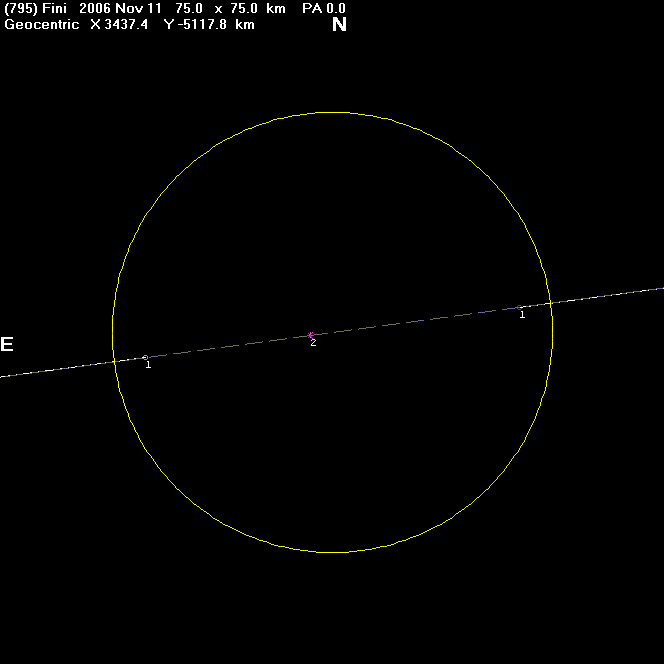
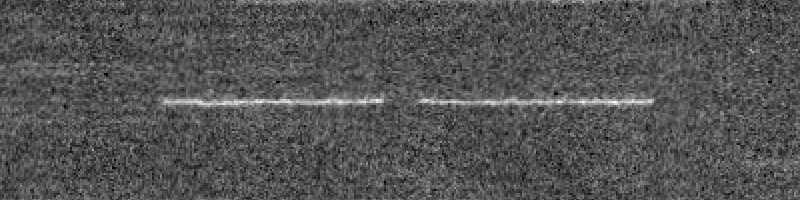
A 4.30 second occultation was recorded by John Broughton at Reedy Creek, QLD, AU, by recording separate CCD images measured photometrically.
View the updated prediction.
Observers:
  1    J. Broughton, Reedy Crk, Australia
Discussion:
The circle above is plotted at the expected 75km diameter of Fini. With only one chord it is not possible to determine whether John was north or south of the central line of the event.
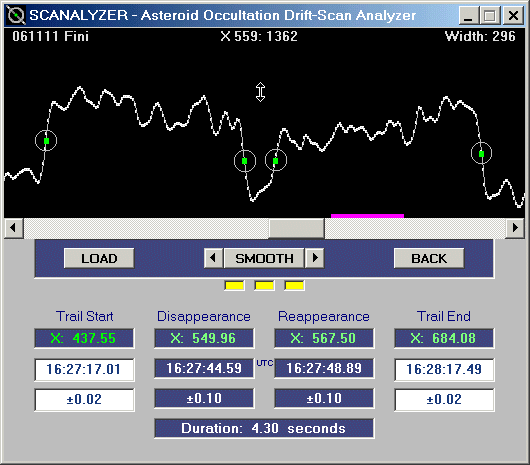
The figures below show the drift-scan image of the occultation together and the data as analysed by John's Scanalyser software.
Observational Data:
Observer's Name                  : John Broughton
Aperture (cm)                    : 25.4
Focal length (cm)                : 169
Type (e.g. SCT; Newtonian)       : SCT
Magnification                    : CCD drift-scan at 4 pps, 50'FOV
Observing site name              : Reedy Creek, Gold Coast
Longitude (East +ve)             : +153 23' 49"
Latitude (South -ve)             : -28 06' 36"
Height above Sealevel (metres)   : 66
Geodetic Datum (e.g.WDD84,NZ1949): AGD66
Sky Transparency (Delete two)    : Good
Star Image Stability (Delete two): Good
Other Conditions:                : light pollution in that northerly direction
TIMINGS:  (PLEASE REPORT IN UNIVERSAL TIME)
Time Source (e.g. WWV, VNG)      : WWVH.
Recording method (e.g. tape)     : Tape.
Could you see the Asteroid?      : Only combined light monitored.
Approx. Limiting Magnitude       : 13
                                          | Estimated  |
                           Universal Time | Reaction   | Accuracy, Remarks
                              h  m  s     | Time (sec) |
   COLUMN FORMAT TO USE--->  __:__:__._        _._       _________________)
Started Observing          : 16:27:17.01       n/a       0.02
Disappearance At           : 16:27:44.59       n/a       0.10
Reappearance At            : 16:27:48.89       n/a       0.10
Stopped Observing          : 16:28:17.49       n/a       0.02
Duration                   :        4.30

ADDITIONAL COMMENTS:
Rigorously timed CCD drift-scan measured in Scanalyzer:
http://www.users.bigpond.com/reedycrk/driftscantiming.htm

This low-elevation event was observed though a gap in trees
from inside the garage using an unpowered SCT in altazimuth mode.
The telescope was visually aligned on a 3rd magnitude star at the instant
it had the same azimuth as the occultation (time found using Guide 8.0).
The declination slow-motion knob was then adjusted a precalculated amount
(to the nearest tenth of a turn) to reach the occultation altitude,
given that each clockwise rotation is known to represent +0.5-degrees
in altitude. An arrow-shaped piece of tape on the end of the knob
served as a dial indicator.

The camera was attached, focused and oriented by trial and error
until north-up, left-to-right trailed images were achieved.

Incidentally, this alignment procedure could also be applied
to video drift-through observations, being far simpler than the
method described in 9.1.3 of the IOTA manual.