
|
|
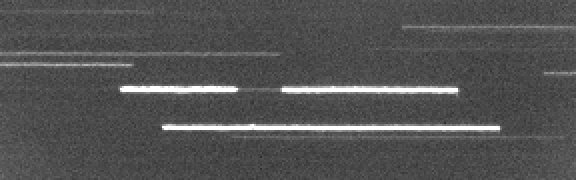
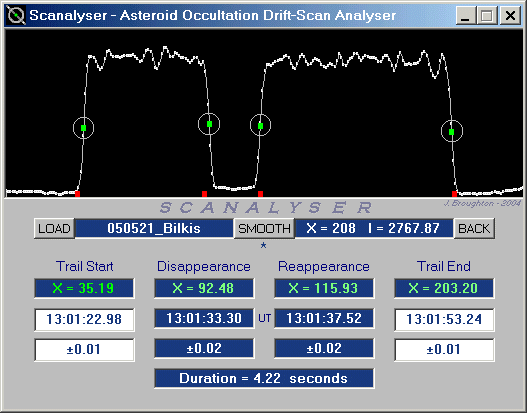
A 4.22 second occultation was recorded using the CCD drift-scan technique by John Broughton in Reedy Creek, Queensland. Peter Anderson in Brisbane, slightly to the north, saw no occultation..
View the Updated Prediction
Observers:
  1    J.Broughton, Reedy Creek, Australia   (CCD)
  2(M) P.Anderson, The Gap, Australia

M = Miss
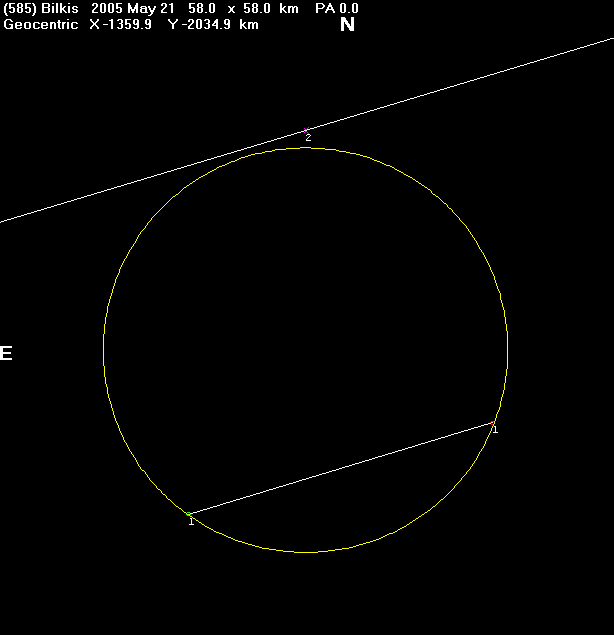
The circle represents the predicted 58 km diameter of Bilkis.
Drift-scan trace:
Scanalyser Trace:
Discussion:
John's observation indicates that the track moved south, compared to the updated prediction, by at least one track-width. If John observed a chord across the southern side of the asteroid, Peter Anderson was unlucky to just be outside the northern edge, assuming the expected diameter of 58 km for Bilkis. However, there remains a chance that the path may have shifted further south, so that John Broughton saw a chord across the northern part of the asteroid.
Observational Data:
Observer's Name                  : John Broughton
Aperture (cm)                    : 50.1
Focal length (cm)                : 185
Type (e.g. SCT; Newtonian)       : Newtonian
Magnification                    : CCD drift-scan at 5.6 pixels per second
Observing site name              : Reedy Creek, Gold Coast
Longitude (East +ve)             : +153 23' 49"
Latitude (South -ve)             : -28 06' 36"
Height above Sealevel (metres)   : 66
Geodetic Datum (e.g.WDD84,NZ1949): AGD66
Sky Transparency (Delete two)    : Good
Star Image Stability (Delete two): Good
Time Source (e.g. WWV, VNG)      : WWVH.
Recording method (e.g. tape)     : Drift-scan. Taped shutter and time signal.
Could you see the Asteroid?      : Visible during occultation.
Approx. Limiting Magnitude       : 15
                                          | Estimated  |
                           Universal Time | Reaction   | Accuracy, Remarks
                              h  m  s     | Time (sec) |
Started Observing          : 13:01:22.98       n.a       0.01
Disappearance At           : 13:01:33.30       n.a       0.02
Reappearance At            : 13:01:37.52       n.a       0.02
Stopped Observing          : 13:01:53.24       n.a       0.01
Duration                   :        4.22

ADDITIONAL COMMENTS: A gibbous moon had little impact on obtaining a first
class drift-scan revealing a stunning dip in it. Observing from just inside
the southern line of uncertainty and outside the nominal path, a positive
occultation was not expected so this was a pleasant surprise indeed.

My Scanalyser software indicated an initial timing accuracy of .04 second
which improved to .02 after only one pass through the smoothing algorithm.

An explanation of methodology and relevant software is available at:
http://www.users.bigpond.com/reedycrk/driftscantiming.htm


Observer's Name                  : Peter Anderson
Aperture (cm)                    : 41
Focal length (cm)                : 245
Type (e.g. SCT; Newtonian)       : Newtonian
Magnification                    : X 198
Observing site name              : Taylor Range Observatory
Longitude (East +ve)             :  152 56 01.4580
Latitude (South -ve)             : -27  27 47.5562
Datum				 : GDA94
Height above Sea level (metres)  : 176.3
Sky Transparency (Delete two)    : Good
Star Image Stability (Delete two): Good
Other Conditions:
     (Wind, Clouds, Lights, etc.): Bright moonlight (93% illum and 34 deg distant)
Time Source (e.g. WWVH, VNG)     : WWVH
Recording method (e.g. tape)     : Stopwatches and tape recorder
Could you see the Asteroid?      : No
Approx. Limiting Magnitude       : 13.0 approx
                                          | Estimated  |
                           Universal Time | Reaction   | Accuracy, Remarks
                              h  m  s     | Time (sec) |
   COLUMN FORMAT TO USE--->  __:__:__._        _._       _________________)
Started Observing          : 12	59 00
Estimated Closest Approach : Definitely no event occurred - Asteroid never seen
                (if no D/R)
Stopped Observing          : 13	04 00

Was your reaction time (also known as Personal Equation) subtracted from
any of the above timings?  : Not Applicable
[Top of Page][Return to Home Page]